
Based on recent industry reporting
Metal additive manufacturing and 3D printed foundry applications · EOS and voxeljet
Metal Additive Manufacturing Support
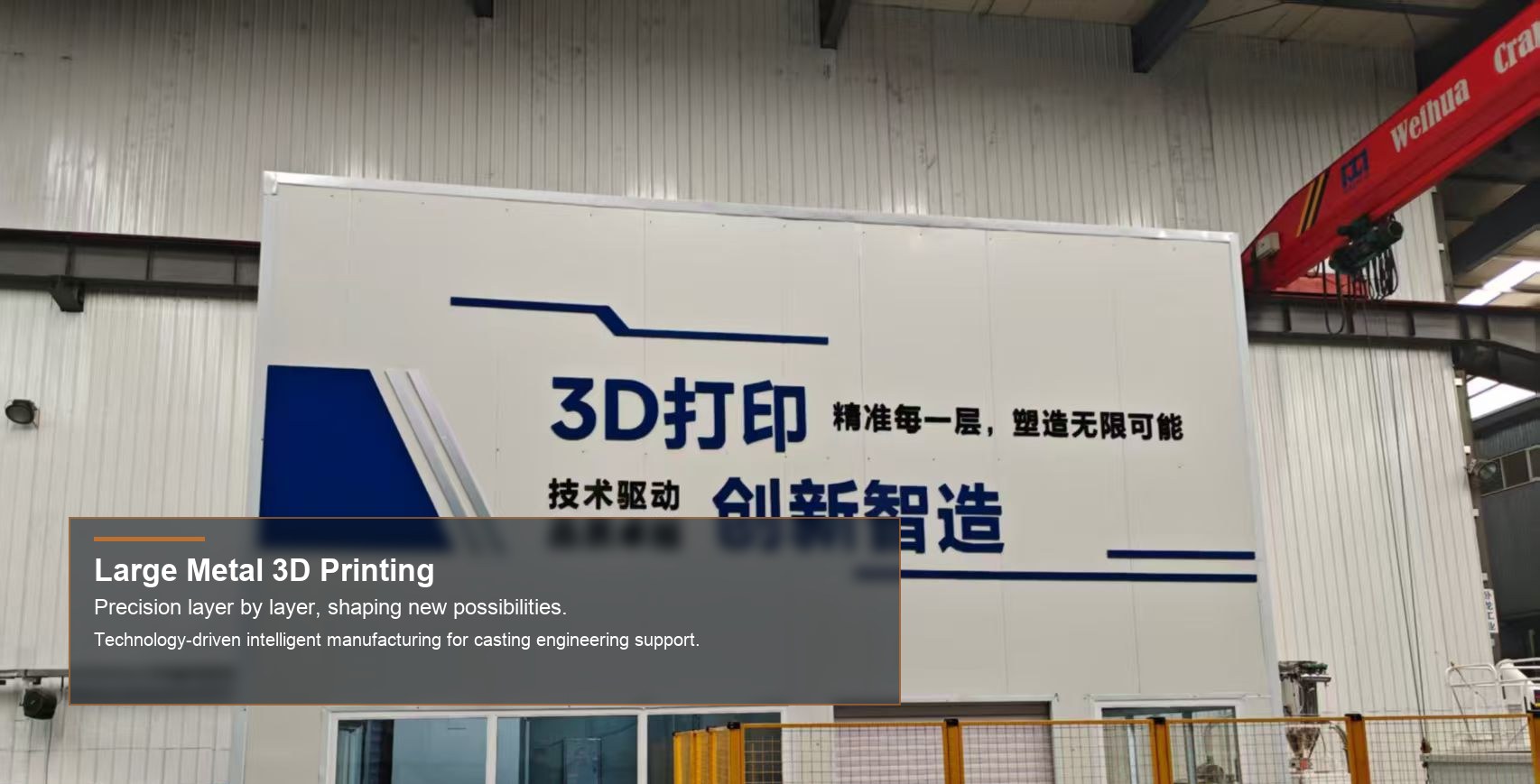
For Hongsen, large metal 3D printing is presented as an engineering support capability around casting, machining, inspection, and export coordination. It helps buyers discuss complex geometry, prototype validation, and process risk before a drawing-based casting project is fixed.
Project Visual
Industrial metal 3D printing is valued for design freedom and complex geometry, while foundry-focused 3D printing is often used to support molds, cores, prototypes, and small-batch validation. For an OEM casting RFQ, the useful question is not whether 3D printing replaces casting, but where it can make early engineering review faster and clearer.
Based on recent industry reporting
Metal additive manufacturing and 3D printed foundry applications · EOS and voxeljet
Complex internal geometry can be discussed earlier when a 3D model is available
Prototype or pilot-batch needs can be reviewed before stable casting production is finalized
Additive review can help identify machining, distortion, inspection, and route-fit questions
The strongest value is in connecting additive manufacturing with casting route selection and CNC follow-up
Review Focus
The best RFQ use is practical and limited: send the drawing, 3D model, sample photos, application notes, and quantity plan so the supplier can judge whether additive support is useful before quotation.
Use it for complex housings, internal passages, lightweight structures, or difficult-to-machine areas
Use it when a prototype, sample validation, or design iteration is needed before batch casting
Use it to clarify whether the final route should remain conventional casting, additive-supported review, or a hybrid discussion
Do not treat it as an instant quote promise; material, inspection, machining, and production route still need engineering review
Quick Facts
A concise summary of project fit, review scope, and RFQ inputs.
Sourcing Focus
Practical guidance for real sourcing questions
RFQ Starting Point
Drawing, quantity, material direction, and machining notes
Project Handling
Drawing review, process discussion, inspection, and delivery coordination
Best Fit
Overseas OEM buyers, sourcing teams, and engineering reviewers
RFQ Focus
Prepare these inputs so material, casting route, machining, and inspection can be reviewed together.
2D drawing, with 3D files if available
Part application, service condition, and destination market
Material grade or at least material direction
Quantity, annual demand, and trial-order expectation
Machining scope, critical tolerances, and inspection requirements
Buyer FAQ
These questions help buyers understand how additive manufacturing can fit into a practical OEM casting conversation.
Not usually. For Hongsen's positioning, casting remains the main manufacturing route. Metal 3D printing is a support capability for complex geometry discussion, prototype validation, and early engineering review.
Mention it when the part has a 3D model, complex internal structure, lightweight design goal, difficult machining areas, or prototype validation need.
A 2D drawing, 3D model, sample photos, material direction, quantity plan, machining notes, and inspection expectations are enough to begin a practical review.
Related Guides
Continue with the relevant material, process, machining, or quality-control topic.
Related Capability Guide
A practical buyer guide comparing lost foam casting and resin sand casting for drawing-based OEM metal parts, including part geometry, size, machining, batch logic, and RFQ information.
Related Capability Guide
Drawing-based custom iron castings for OEM buyers, including process review, material selection, machining planning, and inspection support.
Related Capability Guide
Practical RFQ preparation guide covering drawings, 3D files, material direction, quantity, machining notes, inspection expectations, and project details that help a casting review move faster.
Related Capability Guide
A practical sourcing guide for overseas OEM buyers comparing drawing-based metal casting suppliers, including early technical review, machining, inspection, capacity, and RFQ readiness.
RFQ Focus
Upload the drawing and 3D model so Hongsen can review casting route, additive support potential, machining scope, and inspection focus before quotation.