
D'après des informations sectorielles récentes
Metal additive manufacturing and 3D printed foundry applications · EOS and voxeljet
Metal Additive Manufacturing Support
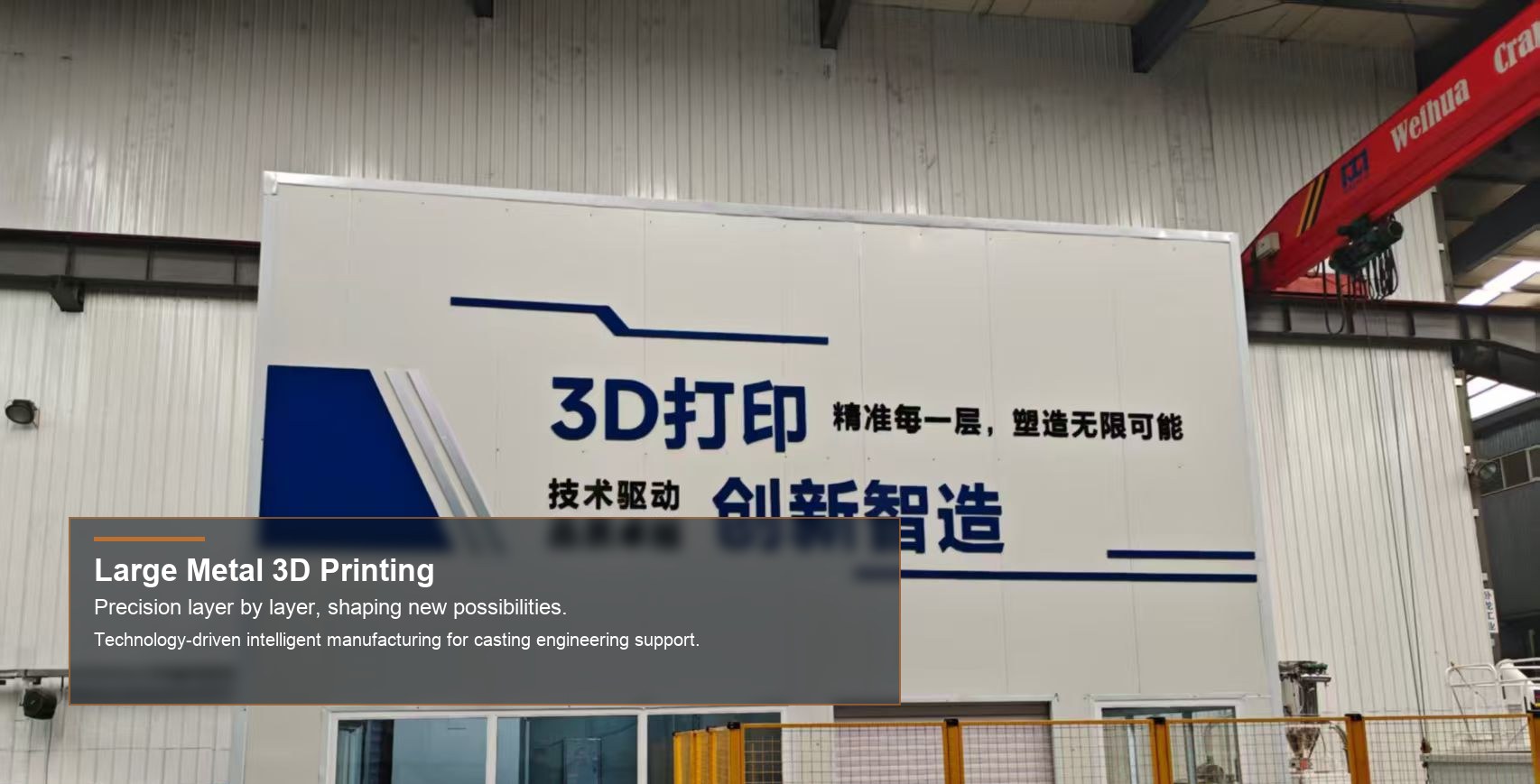
For Hongsen, large metal 3D printing is presented as an engineering support capability around casting, machining, inspection, and export coordination. It helps buyers discuss complex geometry, prototype validation, and process risk before a drawing-based casting project is fixed.
Visuel du projet
Industrial metal 3D printing is valued for design freedom and complex geometry, while foundry-focused 3D printing is often used to support molds, cores, prototypes, and small-batch validation. For an OEM casting RFQ, the useful question is not whether 3D printing replaces casting, but where it can make early engineering review faster and clearer.
D'après des informations sectorielles récentes
Metal additive manufacturing and 3D printed foundry applications · EOS and voxeljet
Complex internal geometry can be discussed earlier when a 3D model is available
Prototype or pilot-batch needs can be reviewed before stable casting production is finalized
Additive review can help identify machining, distortion, inspection, and route-fit questions
The strongest value is in connecting additive manufacturing with casting route selection and CNC follow-up
Points de revue
The best RFQ use is practical and limited: send the drawing, 3D model, sample photos, application notes, and quantity plan so the supplier can judge whether additive support is useful before quotation.
Use it for complex housings, internal passages, lightweight structures, or difficult-to-machine areas
Use it when a prototype, sample validation, or design iteration is needed before batch casting
Use it to clarify whether the final route should remain conventional casting, additive-supported review, or a hybrid discussion
Do not treat it as an instant quote promise; material, inspection, machining, and production route still need engineering review
En bref
Résumé du type de projet, du périmètre d'étude et des données RFQ.
Priorité achat
Informations pratiques pour des besoins d'achat réels
Point de départ RFQ
Plan, quantité, orientation matière et notes d'usinage
Traitement du projet
Revue de plan, procédé, contrôle et coordination de livraison
Pour qui
Acheteurs OEM, équipes sourcing et bureaux d'études
Priorités RFQ
Préparez ces éléments pour examiner ensemble matière, moulage, usinage et contrôle.
Plan 2D et fichier 3D s'il est disponible
Application, conditions de service et marché de destination
Nuance matière ou au moins orientation matière
Quantité, besoin annuel et commande d'essai
Usinage, tolérances critiques et exigences de contrôle
Buyer FAQ
These questions help buyers understand how additive manufacturing can fit into a practical OEM casting conversation.
Not usually. For Hongsen's positioning, casting remains the main manufacturing route. Metal 3D printing is a support capability for complex geometry discussion, prototype validation, and early engineering review.
Mention it when the part has a 3D model, complex internal structure, lightweight design goal, difficult machining areas, or prototype validation need.
A 2D drawing, 3D model, sample photos, material direction, quantity plan, machining notes, and inspection expectations are enough to begin a practical review.
Priorités RFQ
Upload the drawing and 3D model so Hongsen can review casting route, additive support potential, machining scope, and inspection focus before quotation.